Breathwork for Children Who Have Experienced Trauma
Nov 25, 2025
Breathwork for Children Who Have Experienced Trauma
A Nervous System Lens for Parents, Educators & Caregivers
When a child has lived through trauma — big or small, acute or ongoing — their body learns one powerful lesson: stay on alert.
Their breath becomes shallow, fast, or held.
Their muscles stay tight.
Their senses stay wide open, constantly scanning for “What’s next?”
To the outside world, it may look like restlessness, distraction, or refusal.
But it’s not misbehavior.
It’s biology.
It’s a nervous system doing exactly what it was designed to do in a world that didn’t always feel safe.
And while we can’t talk a dysregulated body into calm…
We can breathe it there.
Why Breath Matters After Trauma
Trauma pushes children into survival states designed to protect them:
- Fight — agitation, anger, impulsivity
- Flight — restlessness, hyperactivity
- Freeze — shutting down, zoning out
- Fawn — people-pleasing, collapsing, over-compliance
Each of these states comes with its own breath pattern.
That’s why breathwork is such a powerful tool.
When children learn to change their breath, they learn to change their state.
Slow, long exhales activate the vagus nerve, the body’s internal “you’re safe now” system. This is why Stephen Porges, founder of Polyvagal Theory, highlights breath as one of the most effective ways to shift the nervous system from survival back into regulation.
Breath is the body’s language of safety.
The Part We Can’t Ignore:
Trauma-experienced children cannot begin with deep breathing.
Deep breaths can feel:
- scary
- vulnerable
- exposing
- or even triggering
Why?
Because slowing down feels dangerous to a body that survived by staying hyperalert.
So we start gently.
We build safety one small step at a time.
✔️ Trauma-Sensitive Breathwork Principles for Children
Start with movement before breath
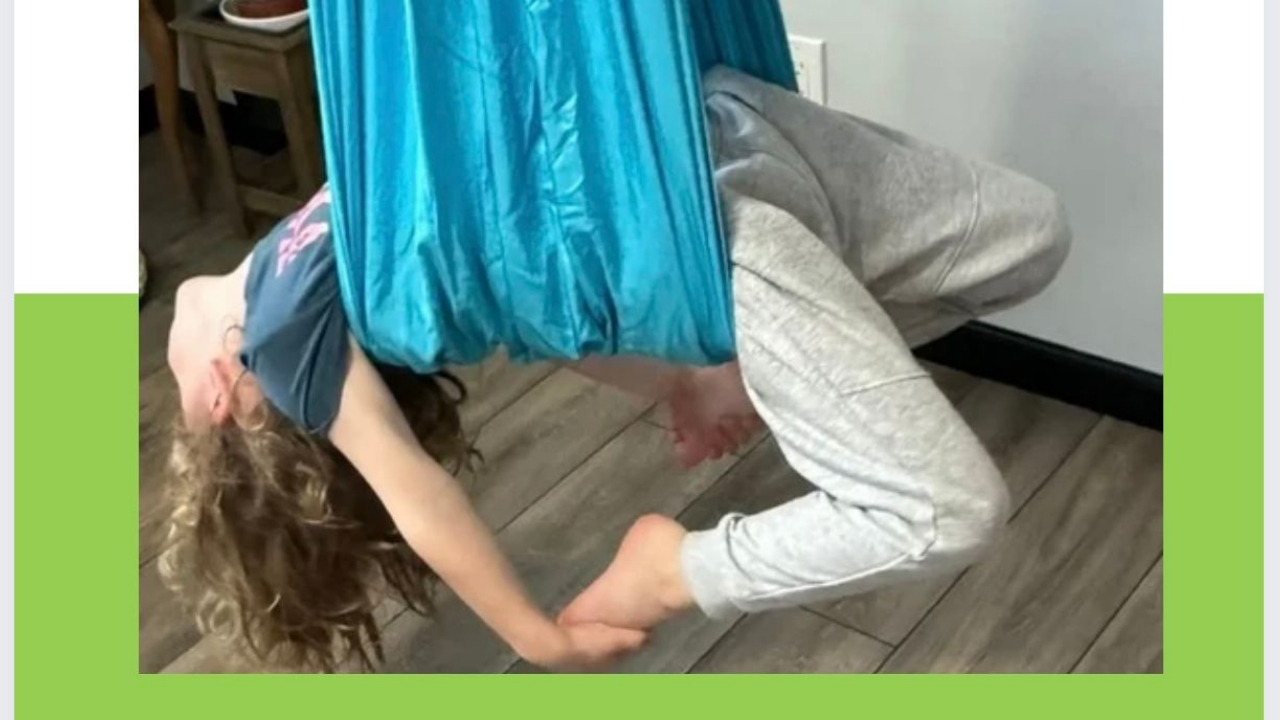
Rocking, rolling, swinging, pushing into walls, bouncing on a peanut ball — these sensory-rich movements organize the body first, making breathwork feel safer.
Movement turns off just enough of the survival response to let breath take the lead.
Make breathing playful, not performative
We don’t tell a child to “Calm down!” or “Take a deep breath.”
Instead, we bring breath into play:
- “Smell the soup… now blow on the soup.”
- “Can you blow this feather across the table?”
- “Let’s make the pinwheel spin slow… now fast.”
- “Pretend you’re blowing up a giant balloon.”
Play disarms the threat response.
It makes regulation feel safe.
Focus on long, slow exhales — not big inhales
Trauma holds the inhale.
Safety lives in the exhale.
Simple cues:
- “Blow out longer than you breathe in.”
- “Let your air out like a long whisper.”
- “Exhale like you’re blowing bubbles.”
It’s the exhale that signals you’re okay.
Use co-regulation — breathe with them
Children don’t learn calm from instructions.
They learn calm from humans.
Your presence.
Your breath.
Your slower rhythm.
Sit beside them.
Breathe slowly.
Let them mirror your pace.
Your regulated nervous system becomes their anchor.
Offer choice, control & permission
Trauma takes away choice.
Breathwork gives it back.
Try:
- “Feather or pinwheel — which do you want to use?”
- “You get to decide how big or small your breath is.”
- “If your body needs a break, you can stop anytime.”
Restoring agency is a core part of healing.
Keep it short and consistent
Just 1–3 minutes is enough.
Short, gentle practices — repeated consistently — rewire the nervous system far more than long sessions.
Regulation is built in small moments.
What Breathwork Gives Traumatized Children
Over time, children begin to experience:
- steadier emotions
- fewer meltdowns
- less hypervigilance
- improved attention
- better sleep
- increased confidence and body awareness
- the ability to pause before reacting
Breath becomes a portable tool they carry everywhere:
home, school, transitions, conflict, sensory overload.
It helps them shift from:
survival → safety → connection
And that shift changes everything.
Unlock Peace and Connection: With an interactive eBook,
Move into Calm 5 Minute tools to Help your Child and You Reset
Stay connected with news and updates!
Join our mailing list to receive the latest news and updates from our team.
Don't worry, your information will not be shared.
We hate SPAM. We will never sell your information, for any reason.